
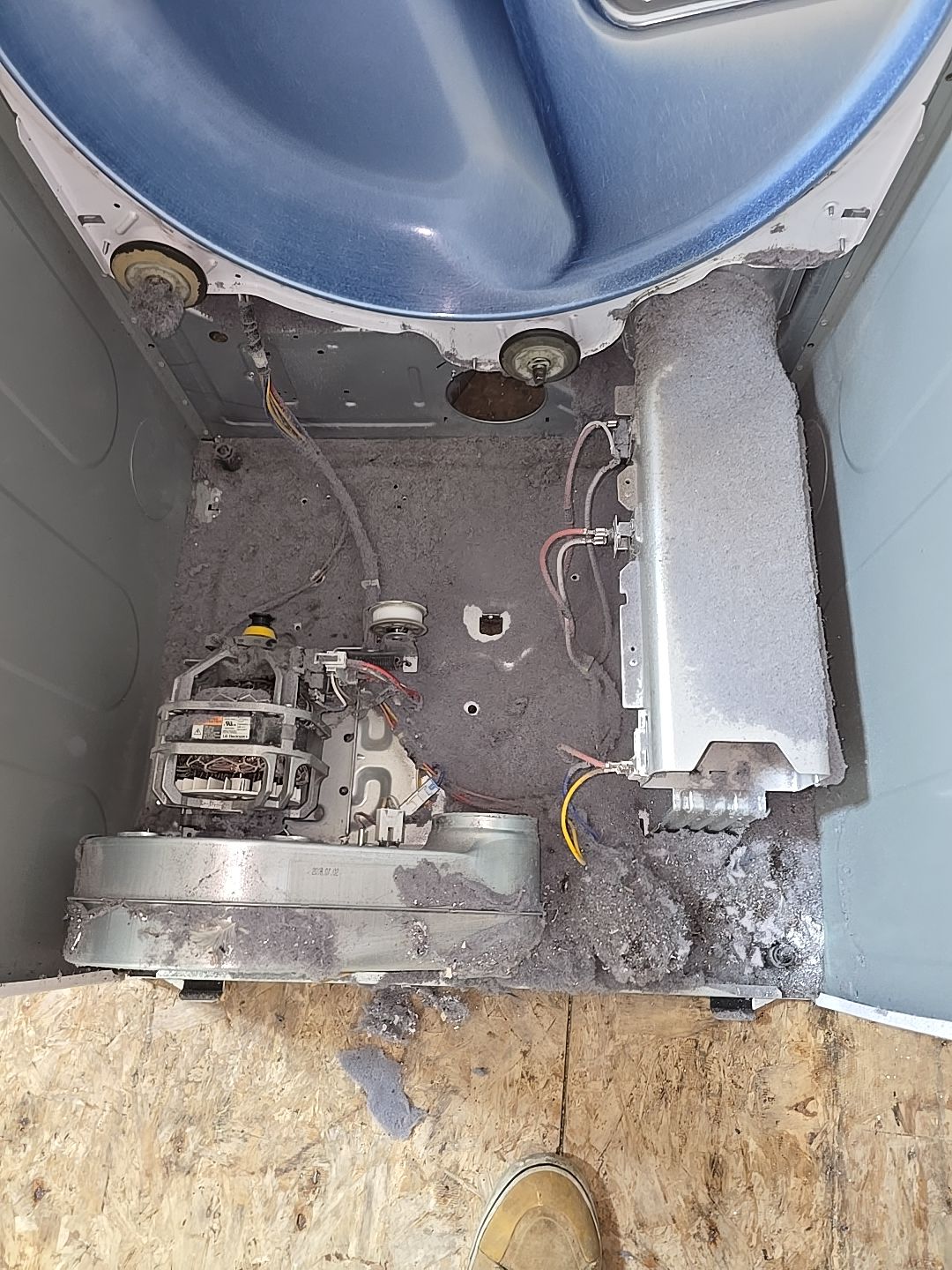
Yes, lint inside the dryer itself is a fire risk
Most people know to clean the lint screen, and many know the vent needs cleaning too. Fewer realize that lint also collects inside the dryer cabinet, the hidden space under and behind the drum. That space holds the heating element on an electric dryer or the burner on a gas dryer, and it is where lint and high heat end up sitting side by side.
Lint is made of fine, dry fibers that catch fire easily. When enough of it piles up on or near the heat source, a spark or an overheated part can ignite it inside the machine, often before anyone notices anything is wrong.
How lint gets inside the cabinet
The lint screen catches a lot, but not everything. Fine fibers slip past it on every load and travel through the blower and ductwork inside the dryer.
Small gaps around the drum seals, the lint screen housing and internal ducts let some of that air and lint leak into the cabinet. Over time it settles on the floor of the dryer, on wiring, on the motor and around the heater housing.
A clogged or restricted vent makes this worse. When air cannot leave the house easily, pressure builds up inside the dryer and pushes more lint out through those gaps and into the cabinet. A worn or torn drum seal does the same thing.
Why the heating element area is the danger zone
On an electric dryer, the heating element is a coil of wire that glows hot inside a metal housing. On a gas dryer, a burner fires a flame into a combustion chamber. Both are designed to heat air moving through them, not to sit under a blanket of lint.
Lint on and around the heater housing traps heat and can be ignited directly. Lint packed around the motor, the blower and the wiring adds more fuel close by.
Dryers have safety parts such as thermal fuses and high limit thermostats that are meant to shut off the heat when things get too hot. Those parts help, but they are not a reason to let lint build up. A heavy layer of lint is fuel, and it does not belong next to a heat source.
Warning signs to watch for
A burning smell while the dryer runs, or a hot smell that lingers in the laundry room afterward.
The outside of the dryer cabinet feels much hotter than usual.
Clothes take longer to dry, or the dryer shuts off partway through a cycle.
You see lint around the bottom edge of the dryer, on the floor behind it, or around the door seal.
If you smell burning, stop the dryer, unplug it if you safely can, and do not use it again until it has been checked. If you see smoke or flames, get out and call 911.
How to keep the inside of your dryer clean
Clean the lint screen before or after every load, and wash it with warm soapy water now and then if it looks clogged with residue from dryer sheets.
Keep the vent clear. A clean, properly installed vent lowers the pressure inside the dryer, so less lint is forced into the cabinet.
Have the inside of the dryer and the vent professionally cleaned on a regular schedule. For most homes, once a year is a good rule of thumb. For busy households that run the dryer every day, large families, homes with pets that shed, or dryers connected to long or hard to reach vents, every six months is a safer choice.
At Two Guys Energy Solutions, cleaning the inside of the dryer is a service we call Dryer Fire Prevention Cavity Cleaning. We remove the panels to reach the cabinet, vacuum out the lint, and clean around the heater housing, motor and blower. It pairs naturally with a dryer vent cleaning, so the inside of the machine and the full length of the vent are both cleared in the same visit. The work requires unplugging the dryer and, on a gas dryer, working carefully around the gas line, so it is a job best left to someone with experience.
Putting the cleaning on the calendar, the same way you would a furnace tune up or a smoke detector battery change, keeps lint from quietly building up between visits.
Written by the team at Two Guys Energy Solutions — serving homeowners from our Treasure Valley and Northern Kentucky / Cincinnati branches.
Request a Free Estimate